
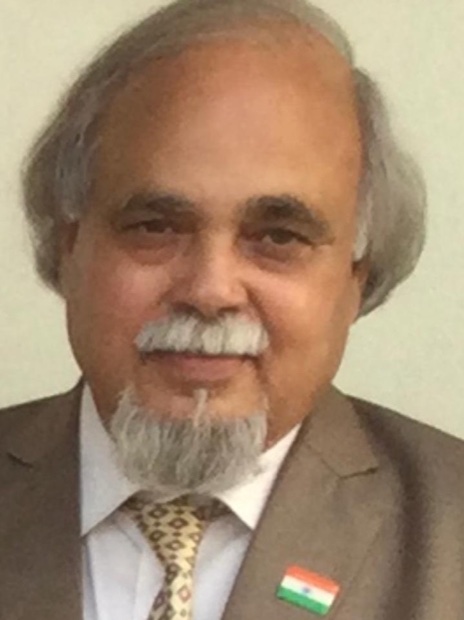
Dr. Satyen Yadav
Plant scientist, agribusiness institution-builder and mentor — four decades spent turning research into livelihoods, and experience into institutions.
A Life Between the Laboratory and the Field
Dr. Satyen Yadav began his career as a researcher in the Kumaun Himalaya, studying how forests hold their nutrients and how trees keep their seasons. That early discipline — patient observation of living systems — has shaped everything he has built since.
After a Ph.D. in Botany from Kumaun University, Nainital and a second master’s in Plant Physiology from G.B. Pant University of Agriculture & Technology, Pantnagar, he spent the 1980s on government and CSIR-sponsored research: the River Gaula Catchment Eco-development Project for the Ministry of Environment, Forests & Wildlife, work on tree physiology, and studies of leaf pigments, root dynamics and forest regeneration that produced more than forty papers in journals including Current Science, Environment and Ecology, Vegetos and the Proceedings of the Indian Academy of Sciences.
In 2000 he founded the Horticulture Produce Management Institute (HPMI), which he still leads as President — and with it moved from studying plants to building the systems that carry them to market. Over the following two decades he authored the concept notes and techno-economic feasibility reports behind Agri Export Zones for potatoes, mangoes and honey in Uttar Pradesh and Punjab; advised Punjab Markfed, Asia’s largest cooperative; opened the Russian market to Indian potatoes in 2009; and promoted Farmer Producer Organisations across Uttar Pradesh from 2013 to 2022.
His work has consistently been designed at national scale. In 2004 he presented the FOOD MART model — an integrated “seed to plate” value chain projected to create 2.5 lakh self-employment opportunities — before a high-level committee chaired by the Secretary, Ministry of Agriculture, Government of India. He demonstrated a mid-day meal operations model across five states, introduced the A2 milk concept to Indian dairy, conceptualised the Pratapgarh Farmers & Agripreneurs Development Authority, and signed an MoU to empower 10,000 farmers through bee-keeping. He continues to work on a Model for Feeding 9 Billion in 2030.
Alongside the commercial work runs a long thread of institution-building for others: SOCH, a charitable organisation he founded in 1990; the SSS Research & Development Foundation; the HPMI India Millet Association; the Bundelkhand Agribusiness Foundation; the Indian Millet Initiative; and the Diksha New World Foundation. He serves as a Trustee of the Namish Foundation, a trust promoted by the Sitapur district administration, and sits on the Governing Council of Alard University, Pune. He is also Founder Chairman of the Seniour Citizen Welfare Association — the Section 8 company under which this Initiative operates.
He has delivered 297 lectures at national and international seminars and workshops, and has worked across North, South and Latin America, the Middle East, South-East and Central Asia, Nepal, Sri Lanka, Bhutan, southern, eastern and western Africa and the European Union. It is this combination — scientific rigour, commercial realism and a habit of building things that outlast him — that he brings to the Seniour Scholars & Innovators Initiative as its Founder and Promoter.
Present Engagements
Institutions Dr. Yadav currently leads, chairs, directs or serves.
Work That Changed Practice
A selection of models, markets and institutions built over four decades of national and international practice.
Founded SOCH
Established SAI Organization of Creative Help, a registered charitable society, and continues as its Chairman.
Founded HPMI
Promoted the Horticulture Produce Management Institute — the platform from which two decades of agri-export, cooperative and farmer-producer work would follow.
Agri Export Zones for India
Authored concept notes, pre-feasibility and techno-economic feasibility reports for Agri Export Zones covering potatoes, mangoes and honey, submitted to the Department of Horticulture, Government of Uttar Pradesh and to Punjab Markfed, Chandigarh.
The FOOD MART model
Presented an integrated “seed to plate” value-chain model projected to create 2.5 lakh self-employment opportunities, before a high-level committee chaired by the Secretary, Ministry of Agriculture, Government of India, on behalf of the Government of Uttar Pradesh.
Mid-day meal operations model
Demonstrated a working model for mid-day meal operations across Uttar Pradesh, Himachal Pradesh, Uttarakhand, Punjab and Andhra Pradesh.
Opened the Russian market
Established the Russian market for Indian potatoes, extending export reach for growers in Uttar Pradesh and Punjab.
Pratapgarh Authority & Farm-to-Fork
Conceptualised the Pratapgarh Farmers & Agripreneurs Development Authority, and presented the “Farm to Fork” food retail model at Lucknow.
A2 milk & bee-keeping empowerment
Introduced the A2 milk concept to Indian dairy, and signed an MoU to empower 10,000 farmers and agripreneurs across Uttar Pradesh and Uttarakhand through bee-keeping. Delivered the lead lecture on farmer empowerment at the 7th Agriculture Leadership Summit, New Delhi.
Farmer Producer Organisations
Sustained promotion of FPOs across Uttar Pradesh over nine years, alongside invited lectures at the National Agriculture Congress (NDRI Karnal) and Vibrant Saurashtra on Indo-South African agribusiness.
Feeding 9 Billion in 2030
Currently developing a model for global food security in 2030 and a hunger-free India, with published analyses on feeding the world through the Planetary Project.
Qualifications
- Ph.D. (Botany) — Kumaun University, Nainital
- M.Sc. (Botany) — Kumaun University, Nainital
- M.Sc. (Plant Physiology) — G.B. Pant University of Agriculture & Technology, Pantnagar
- Certificate courses in Photogrammetry & Remote Sensing — Indian Institute of Remote Sensing, Dehradun
- Nine specialised training courses and workshops at Indian and foreign institutes and universities
Scientific Work
- Effect of Zinc on photosynthesis and photo-respiratory metabolites in sunflower — 1980–81
- Phenology of evergreen and deciduous species of the Kumaun Himalaya — 1982–83
- River Gaula Catchment Eco-development Project — Department of Environment, Forests & Wildlife, Government of India
- Tree physiology — sponsored by C.S.I.R., New Delhi, 1987–89
Over forty papers published on forest ecology, photosynthetic pigments, root dynamics, seed pathology and, later, agribusiness and food security — including work on Ginkgo biloba, Quercus root dynamics and forest regeneration indicators.
Honorary Engagements & Memberships
Honorary Positions
- Chairman — SAI Organization of Creative Help, a registered charitable society
- Councillor — International Journal of Agricultural and Biological Research
- General Secretary — Ecology Research Circle, promoted by Kumaun University, Nainital
- Nominated member — Pratapgarh Farmers & Agripreneurs Development Authority
- Business Development Director (India) — Planetary Projects
- Advisor — Shri Krishnayan, an indigenous cow protection and conservation trust
Professional Societies
International Exposure
Collaborations Built
Memoranda of understanding and advisory relationships established with governments, cooperatives and universities.
“Experience Should Never Retire.”
The Initiative was founded on the belief that a lifetime of judgment, networks and institutional memory is a national asset — one that deserves purpose, dignity and a place to keep working.